
Handling
Snails are safe and easy to handle making them ideal for children. However, as for most animals it is prudent to wash your hands after handling your snails. Likewise, wash your hands before you handle your snails to make sure no chemicals and/or detergent come into contact with your snails and harm them. For anyone who has obtained a wild-caught specimen and is worried about catching something from then click here.
Shell
The shell is reasonably robust but at the opening you will see layers of new growth that are very fragile and will break easily if touched so try not to handle the snail at that point. However, it is likely that this will chip or break from time to time and is easily repaired by the snail with a plentiful supply of calcium. Snails do seem to get their shells scratched so minor scarring is perfectly normal and doesn't seem to bother them. For more detailed information concerning damage click here.
Picking Up
To get a snail off the side of the tank it is best to spray the snail and your hand and then gently slip your finger under its head. Then, using both hands, slide your finger all the way under its whole body, while very gently pulling it off and supporting it with your other hand. If it doesn't want to let go, don't try and force it. If you can't get your finger under its head, you can encourage the snail to lift and stretch upwards by offering a piece of its favourite food slightly out of reach. Snails just can't seem to resist food placed in front of them.
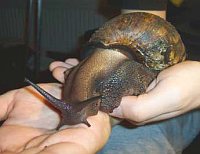
Make sure that you wet your hand before placing the snail on your palm. Perhaps the easiest position is to place the snail with his head facing your wrist - that way, you can support the point of the shell with your fingers, while your hand remains still, and you can easily observe as your snail emerges from his shell. However you do it, remember to support the snail from underneath to prevent a 'butterfingers' moment.
The picture to the left is obviously showing the snail to the camera but it is a good example of how you should support the snail.
For juvenile snails, you can very gently slide them to break the suction. Give the snail, the surface it is on and your finger tips a good spray first. Then cup you hand around the snail so you are supporting the shell but actually touching the snail's foot where it meets the surface level with the pads of your fingers. Then very gently slide the snail's foot, not the shell. Always play safe, if it isn't happening, try again later or try encouraging them to move onto something flat you can pick up.
For tiny snails, it is advisable to put a piece of food near them, wait ill they have boarded it and move that. Small snails are very delicate.
When removing the lid of your tank extremely careful if your snail is stuck on it as a fall could be fatal. In situations where a snail is half on the side of the tank and half on the lid it is better to come back another time rather than taking the risk of it falling off.
Water
Land snails need to breathe so they should never be completely submerged in water. When spraying with water make sure it is tepid or at room temperature if you have central heating.