
From time to time you may experience problems with your snails. Very little is known about what these illnesses are, what causes them, and even less is known about treatments. Unfortunately it seems more time is spent on increasingly more ingenious ways to kill them.
Because of this, the following information is a mix of whatever research is possible and available, theory and hypothesis, logical thinking and the result of various discussions with a large group of snail owners. It is with the help of the community at large, that these problems can at least be documented. Where possible I have tried to link to example incidents.
Hopefully, we can find some effective solutions to the majority of these problems but for now I'm afraid you'll have to be content with various suggestions and discussion.
Bad Shell Growth
Lack of Calcium
Do your snails eat the calcium you provide? Healthy, growing snails demolish cuttlefish. Even if you don't witness them rasping it, they should leave unmistakable marks all over their source of calcium. If you are mixing it in with their food perhaps you aren't giving enough. Unless you are limiting calcium for a good reason it is always wise to supply a supplemental source that they can choose to eat. Calcium deficiency can cause bad shell growth as shown in Fig. 1 below or particularly thin growth. However thin growth can look perfectly healthy.
Lack of Nutrients
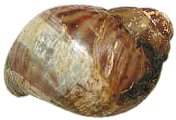 Fig. 1
Shells are made of substances other than calcium carbonate.
There is some evidence to suggest that lack of vitamins, particularly Vitamins D (see Lack of Sunlight below) can cause some shell deformities, particularly like Fig. 1. In this particular case, liquid multi-vitamins for reptiles was employed and the deformity ceased to continue.
It is known that a number of minerals, phosphorus in particular, are needed to for the body to process calcium and this is likely to be the case for snails.
A number of us are conducting some trials to try and identify what solutions work, but without a huge group of snails and proper scientific approach, progress will be slow.
Lack of Sunlight
Vitamin D is created by the body in the prescence of UV light. In particular Vitamin D3 increases calcium absorption by as much as 30 to 80 percent. Vitamin D can be supplied in milk powder and supplements. Some plants contain it, as do some cereal crops such as hemp.
Myself and others intend to obtain a UVa and UVb setup intended for reptiles. UV is known to fade the shells and even though the snails will spend a great deal of time buried or hidden during daylight it is known that even during daylight snails are active if the humidity is high, such as after rain. The other advantage of supplementing UV is to regulate day-length better.
Growing too fast
It is possible that when given rich and plentiful diets, some could snails' bodies could grow too fast for the snail to grow a good shell. This seems slightly unlikely in light of Hodasi's studies on Achatina achatina, fed nutritious diets. His snails grew very quickly and did not suffer shell problems, that I am aware of.
Too much calcium?
Assuming the problems aren't caused by any of the above, there is one other hypothesis. Sherlock Holmes once remarked that when all likely explanations are ruled out, any remaining possibility, however unlikely, must be correct. If you look at the calcium content of various foods, even calcium rich foods like papaya have a content of less than 1%. This means either:
- The foods contain perfect levels of the other ingredients to help shell growth.
- The snails get calcium from other sources.
If neither of the above are true then perhaps in captivity, snails can get too much calcium which causes excessive deposits on the shell and uneven growth.